
A good short script is one idea, said out loud, in the order a viewer needs it: hook, point, proof, close. It's short enough to say in under a minute, written in sentences you'd actually say, and split into lines you can record one take at a time. You don't need a teleprompter or a perfect draft, just a first and last line you know by heart and a middle you can say in your own words.
The four-part structure
Almost every talking-head short that works follows the same shape:
- Hook. One sentence that makes the next one worth hearing. See how to write a hook for formulas.
- The point. The one thing you want the viewer to remember, said plainly.
- The proof. An example, a number, a quick story or a before-and-after that makes the point believable.
- The close. What to do next, or a line that lands the idea. One call to action, not three.
If you find a second point while writing, it's your next video, not a paragraph in this one.
How long should it be?
Most people speak at about two and a half words per second on camera, a little faster than in conversation. That gives you a simple budget:
| Video length | Words, roughly | Sentences |
|---|---|---|
| 15 seconds | 35 to 40 | 3 to 4 |
| 30 seconds | 70 to 80 | 6 to 8 |
| 60 seconds | 140 to 150 | 12 to 15 |
Write to the budget, then cut a little more. The edit removes pauses and restarts, but it won't make a long idea short.
Write for the ear, not the page
A script is something you say, not something someone reads. Read every line out loud before you record it; if you stumble on it, the viewer will too.
Cut:
- "Lighting is one of the most important factors to take into consideration."
- "In this video I'm going to explain three different reasons why…"
- "Utilize natural light sources whenever it is feasible to do so."
Keep:
- "Light changes everything."
- "Here are three reasons."
- "Face a window when you can."
Word for word, or bullet points?
You don't have to memorize the whole thing. A split that works for most people:
- Hook: word for word. It's the line that decides whether anyone stays, so every word counts.
- Middle: bullet points. Note the point and the proof, and say them in your own words. You'll sound like yourself, not like you're reading.
- Close: word for word. A clear last line keeps you from trailing off with "so, yeah…".
A full example
Here's a 30-second script for a talking-head tip, written to be recorded line by line:
Your videos look dark because the window is behind you.
Turn around.
Face the window, and put your phone between you and the light.
Your face gets soft, even light, and the camera stops fighting the background.
I moved my desk thirty centimeters and stopped editing my exposure.
Try it on your next video, and check the difference in the first frame.
That's six lines and about 70 words: a hook, the point, why it works, a quick proof and a close.
Record it in sentence-sized takes
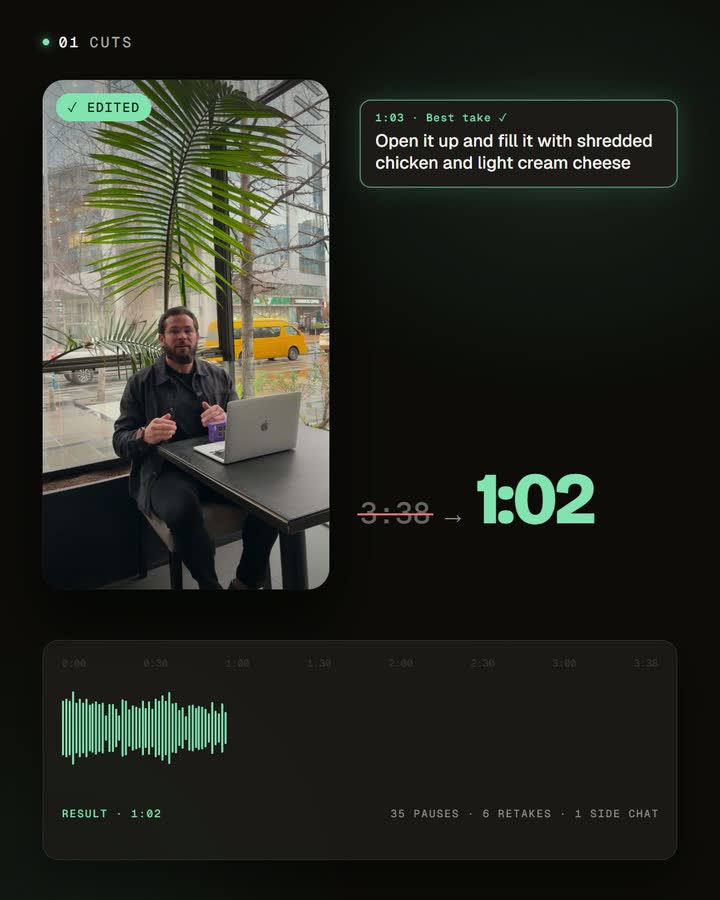
Your script is also your recording plan. Say one line, pause, say the next. When a line goes wrong, don't stop the recording: pause, and say the whole sentence again from the start. Restarting at the beginning of the sentence gives the edit a clean take to keep.
For the camera setup, see how to record a talking-head video on your phone.
Mistakes that make scripts sound read
- Too many points. One idea per video. The second one dilutes the first.
- A long setup. Context before the hook loses viewers before you've said anything.
- Written words. "Utilize", "furthermore", "in order to": if you wouldn't say it to a friend, don't say it to the camera.
- A vague close. "Hope this helps" isn't a close. Tell the viewer what to try, or end on the strongest line.
Frequently asked questions
How long should a script be for a 30-second video?
About 70 to 80 words, or six to eight short sentences. Read it aloud with a timer: if it runs over, cut a sentence rather than talking faster.
Should I memorize my script?
Only the first and last lines. Keep the middle as bullet points and say it in your own words.
Do I need a teleprompter?
Not for a short. Recording one line at a time from memory usually looks more natural than reading.
Can I use AI to write my script?
As a first draft, yes. Then read it aloud and rewrite every line in the words you'd actually use.
Write one script today
Pick one idea you explain often. Write the hook and the close word for word, note the point and one proof in between, and read it aloud with a timer. If it fits in 30 seconds, record it line by line.


